Countertops
Countertop Installation in Lake Oswego, OR
Planning new counters? Have a local contractor look at your kitchen.
Choosing a surface you will use every day
Counters take more daily wear than almost anything else in a kitchen: hot pans, knives, spills, wine and cleaning sprays. The right material depends on how you cook, how much upkeep you will tolerate and the look you want. Installation matters as much as the slab, because a counter is cut to fit cabinets, walls, a sink and a cooktop that are never quite perfect.
Below is a comparison of the usual materials, plus a walk through templating, seams, overhangs, edges and cutouts, so you can ask good questions. We are a referral service and do not fabricate or install counters. We pass your request to an independent local contractor, who measures the kitchen and gives you an estimate.
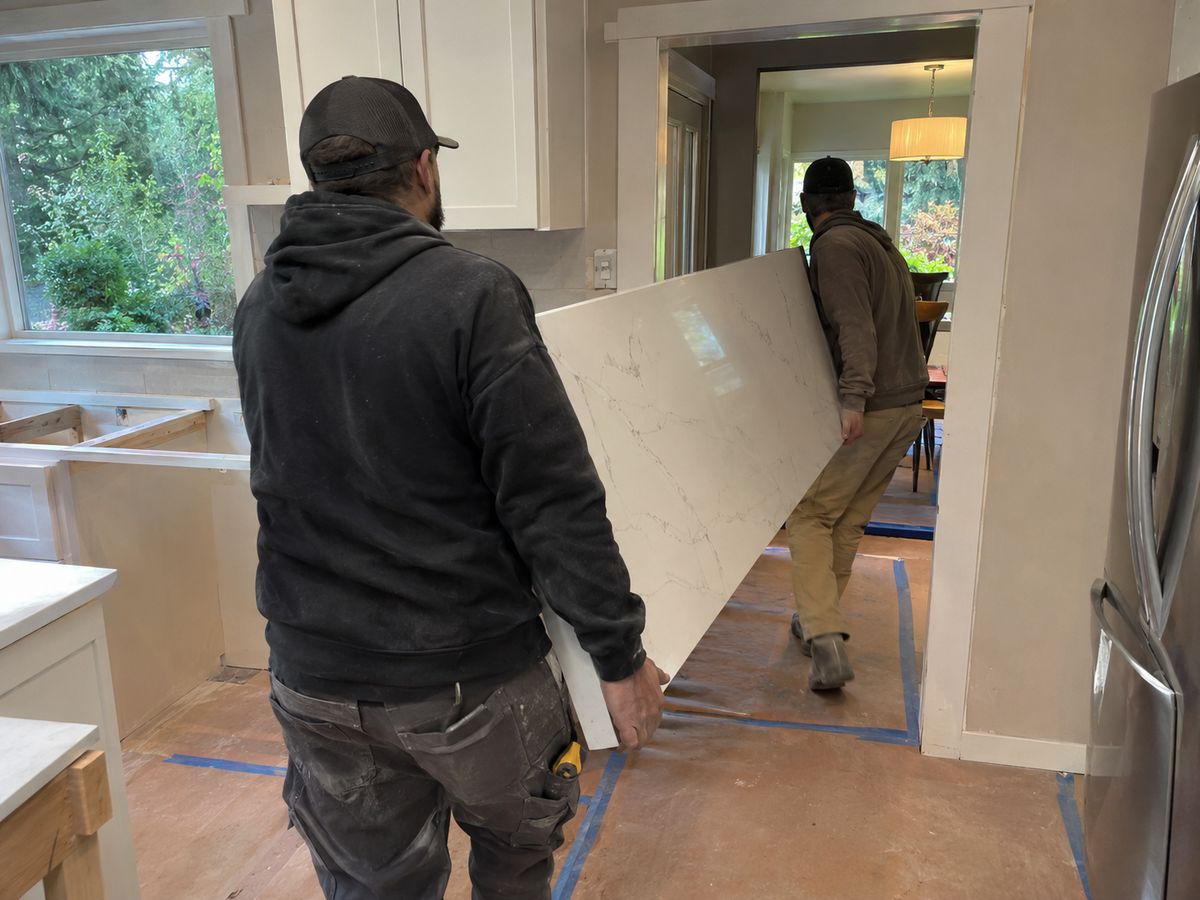
From slab choice to finished counter
Two of the topics below are about material, and three are about how a slab becomes a counter in your kitchen. Material sets the look and the care routine. Templating, edges and cutouts decide how well it fits and how it holds up.
Quartz and solid surface
Quartz counters are engineered from crushed quartz bound with resin. They are nonporous, so they do not need sealing, and the color is consistent from slab to slab, which makes seams easier to match. The resin is the weak point with heat. A hot pan set straight down can scorch or discolor it, so trivets are a habit worth keeping.
Solid surface is an acrylic or polyester material that can be joined with nearly invisible seams and formed with an integral sink. It is softer than stone, so it scratches more easily, but light scratches can usually be sanded out. It suits households that value easy repair over hardness.
Granite, quartzite and marble
Natural stone varies from slab to slab, so choose the actual slabs if you can rather than a small sample. Granite is hard and handles heat well, but it is porous to a degree and many types need periodic sealing. Quartzite is a natural stone that is often harder still, and it is sometimes confused with quartz. Ask what the stone really is, since some stones sold as quartzite behave more like marble.
Marble is softer and reacts with acids. Lemon juice, vinegar and some cleaners can etch dull marks into the polish. Some people accept that patina in exchange for the look, while others keep marble to a baking area.
Templating, seams and overhangs
Counters are templated after the base cabinets are installed and fastened, because the final shape has to follow the real cabinets and walls. The fabricator traces or digitally measures every edge, the sink and cooktop positions and any wall that bows. Before that visit, have the sink, faucet and cooktop delivered or their spec sheets ready.
Slabs have a maximum size, so long runs and L-shapes often need a seam. Ask where seams will fall and keep them away from the sink and cooktop where you can. Overhangs beyond a modest depth need hidden steel or corbels for support, especially at seating. The fabricator can tell you what your material requires.
Edge profiles
The edge is a small choice with a large visual effect. An eased edge, a square edge with slightly softened corners, looks clean and modern and chips less than a sharp corner. A bullnose or half bullnose rounds the edge and is gentler on hips and small children. Ogee and other decorative profiles suit traditional kitchens.
Some stones look thicker with a mitered edge, where a strip is joined to the front so the counter reads as a solid block. That takes precise fabrication, and the joint shows more in some patterns than in others. Before deciding, look at the edge cut on a piece of your actual material.
Cutting for the sink and cooktop
With an undermount sink, the bowl is fixed beneath the stone, leaving the cutout edge polished and on view. The fabricator needs the sink in hand or its exact dimensions, and the sink is held up with clips or brackets, sometimes with extra support from below. A drop-in sink rests its rim on the counter and is more forgiving of small errors. Faucet, soap dispenser and filter holes are drilled to your plan.
A cooktop cutout follows the manufacturer's dimensions and clearances, and stone around a cooktop needs enough material left at the front and back to resist cracking. Narrow strips may need reinforcing. Confirm the appliance model before templating so the opening matches it.
Why Request Countertop Installation Through Us
Straight talk about each surface
The contractor can explain the care, heat tolerance and wear of each material, not just how it looks in a showroom.
Fit based on your cabinets
Counters are templated from your installed cabinets and walls, so the fit comes from the real kitchen rather than a floor plan.
A request without obligation
Sending a request does not commit you. You choose the material, review the estimate and decide whether to hire.
How a countertop installation unfolds
- Pick material and slabsYou choose the material and, for natural stone, ideally the specific slabs, along with the edge profile.
- Settle sink, faucet and cooktopModels are confirmed so cutouts and drilling can be planned around real dimensions.
- Template on siteWith base cabinets fixed and level, every edge, seam and cutout is measured in the kitchen.
- Fabricate and setThe slabs are cut, edged and polished, then set on the cabinets with seams joined and supports added where needed.
- Hook-up and care notesThe sink and cooktop are reconnected by the right trades, stone is sealed if required, and you get care instructions.
Countertop Installation Questions
Is quartz the same as quartzite?
No. Quartz counters are engineered from crushed quartz and resin, so they are uniform and nonporous. Quartzite is a natural stone cut from quarried blocks, with natural variation and, depending on the stone, a need for sealing. Ask the supplier to confirm what the slab really is.
How do I care for natural stone counters?
Wipe up acidic spills such as citrus, wine and vinegar quickly, use pH-neutral cleaners, and reseal porous stone as the fabricator recommends. A simple water test helps: if droplets darken the stone after a few minutes, it may be time to reseal.
Can I set hot pans on my countertop?
Granite and quartzite tolerate heat better than most surfaces, but sudden heat can still stress stone near a seam or a cutout. Quartz and solid surface contain resin that can scorch. A trivet or hot pad is the safe habit with every material.
How far can a countertop overhang for seating?
It depends on the material, its thickness and the support underneath. Modest overhangs can often stand on their own, while deeper seating overhangs usually need steel supports or brackets. The fabricator sets the limit for your slab, so plan seating before templating.
Other Services in Lake Oswego, OR
- Kitchen Remodel
- Custom Kitchen Cabinets
- Cabinet Refacing
- Kitchen Island Installation
- Open Concept Kitchen
- Kitchen Remodel in Lake Oswego, OR
Towns We Take Requests From
Call for a Free Estimate
Tell us about the counters you are considering and the kitchen they will go in. We will pass your request to an independent contractor in Lake Oswego.